
You Don’t Have a Marketing Problem. You Have a Timing Problem
Let’s be real—most entrepreneurs don’t lack ambition. If you’re like the business owners we work with at ImpactLine Digital, you’ve got big dreams, big goals, and probably a whiteboard full of revenue targets.
But here’s what we’ve noticed:
Even the smartest founders run into the same trap.
They create goals… but don’t match them with the right kind of marketing.
They chase long-term brand building when what they really need is short-term cash flow.
Or, they burn their budget trying to generate instant leads with campaigns that aren’t designed for quick conversion.
It’s not that the marketing is “wrong.” It’s just misaligned with the timeline of your goal.
So how do you fix that?
That’s where the ABC Goals Framework comes in.
What Are ABC Goals?
ABC Goals are a simple way to structure your revenue priorities based on time horizon. They help you clarify what kind of revenue you’re targeting—and what kind of marketing is appropriate for each phase.
- A-Type Goals = What do I need to make in the next 30–60 days?
- B-Type Goals = What do I need to build over the next 3–6 months?
- C-Type Goals = What’s my vision for the next 12+ months?
Once you sort your goals by timeline, you can build a marketing strategy that’s responsive, realistic, and sustainable.
Pro tip: Marketing isn’t just about choosing tactics. It’s about choosing timing.
A-Type Goals: The 60-Day Sprint
Let’s say you’re staring at your calendar and thinking:
“I need to bring in $10,000 this month.”
“I’ve got spots to fill—yesterday.”
“I’m behind on cash flow and I need leads now.”
That’s an A-Type Goal.
These are short-term revenue targets. You’re not trying to build a brand. You’re trying to survive—or hit an immediate milestone.
So what kind of marketing works here?
You need fast, direct response tactics:
- Flash sales or limited-time promos
- Paid ads targeting warm audiences
- SMS campaigns or email offers with urgency
- Strategic outreach to referral partners
- Local SEO campaigns with call-to-action offers
And yes—this is where events shine.
The right kind of event can unlock instant visibility and sales. Think:
- Pop-up booths at local gyms or farmers markets
- Open house events (“Try It Free” or “Bring a Friend” days)
- Fast-turnaround co-hosted activations with nearby businesses
- Free consults or mini-assessments offered on the spot
You’re not building a community—you’re activating a sale. And in-person energy can convert in a way that digital never will.
Think of A-type events like the “sprint drills” of your marketing plan: fast, sweaty, and focused on performance.
B-Type Goals: The Sustainable Climb
You’ve got some stability. Maybe you hit last month’s goals. You’re breathing easier—but now you’re thinking long-term:
“I want to grow my monthly recurring revenue.”
“I need to build a stronger pipeline.”
“I want to double my client base by the end of the quarter.”
That’s a B-Type Goal.
Here, the focus shifts from “emergency revenue” to “strategic growth.” You’re playing the medium game.
What works here?
- SEO strategy to increase organic discovery
- Email marketing to nurture leads
- Funnel building (lead magnet → nurture → offer)
- Repurposing social content for consistency
- Reviews, testimonials, and video case studies
Now, let’s talk events.
B-type events are about education, trust, and lead capture. You’re meeting people who are curious—not ready to buy yet.
Here’s what’s effective:
- Monthly free workshops (on topics your leads are Googling)
- Local panels or expert nights with other providers
- Wellness days at coworking spaces, salons, or boutique hotels
- Free community classes that funnel into your paid programs
The goal isn’t to sell on the spot. It’s to build relationship equity—and move people further down the buyer’s journey.
💬 Think of B-type events as the “coffee dates” of your marketing—low-pressure, relationship-focused, and designed to build familiarity.
C-Type Goals: The Long Game
These are your vision-level goals. The big ones.
“We want to launch our flagship program next year.”
“I want to be known in my industry.”
“We’re building a brand that lasts.”
That’s a C-Type Goal.
It’s less about this month’s revenue and more about brand legacy. But don’t let that fool you—C-type goals are still very strategic. They require investment, but they pay off in authority, media visibility, and market leadership.
Your marketing strategy here includes:
- Thought leadership content (blogs, podcasts, guest interviews)
- YouTube or evergreen educational content
- Social storytelling and founder branding
- SEO-driven pillar content
- Strategic partnerships and press
Events become powerful brand assets at this stage.
This is where you host:
- Flagship annual retreats or conferences
- Media-worthy launch parties
- Signature branded experiences (e.g. “Biohack Your Nervous System Day”)
- Speaking engagements and workshops at industry events
These events require more resources, but they position you differently. You go from “local provider” to community leader and expert voice.
🧱 C-type events are like building a cathedral—you’re laying foundation for something people will remember (and want to come back to).
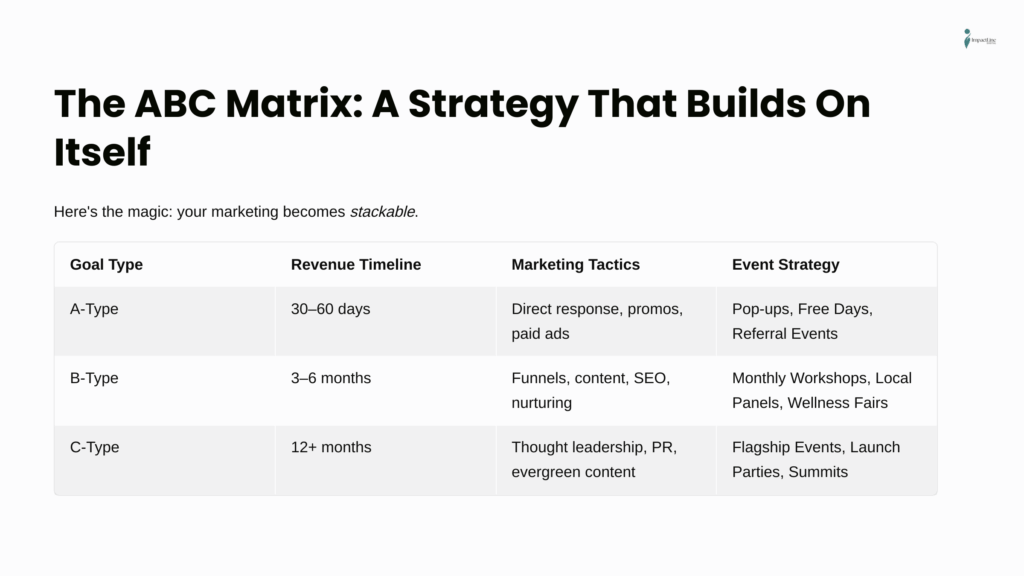
Done well, your A-type activities feed your B-type momentum, which builds your C-type brand vision. It’s not about choosing one lane—it’s about layering the lanes with intention.
Real Life: How a Regenerative Medicine Practice Stacked Events to Align With ABC Goals
Let me share how one of our regenerative medicine clients put the ABC Goals framework into action—and turned scattered marketing into strategic momentum.
They came to us with a clear challenge:
“We’ve got amazing services and a world-class team, but our leads are unpredictable. Some months are great, others are crickets. We need a plan that supports short-term wins and long-term positioning.”
So we mapped out their revenue goals across three timelines:
A-Type: Generate Revenue in the Next 30 Days
Tactic: We hosted a live webinar focused on their highest-demand service—platelet-rich plasma (PRP) therapy for joint pain.
Why it worked: It attracted ready-to-buy leads, allowed them to build authority fast, and ended with a limited-time consultation offer.
Result: 5 consults booked in one week
This wasn’t about branding—it was about immediate cash flow. And the webinar was the perfect fast-conversion event to make it happen.
B-Type: Build the Pipeline for the Next 3–6 Months
Tactic: They sponsored a local wellness expo and ran a booth offering free posture assessments and consultations.
Why it worked: It positioned the brand in front of a wellness-curious crowd and allowed the team to build trust through face-to-face conversations—without the pressure to sell immediately.
Result: 76 leads entered their CRM with segmentation tags for pain type and treatment interest, feeding their automated email funnel.
This was a long play—but it gave the sales team a warm list to nurture for the next few months.
C-Type: Own the Local Market in the Next 12 Months
Tactic: They hosted a Community Open House, inviting past patients, referral partners, and local influencers.
Why it worked: It wasn’t about selling—it was about visibility, gratitude, and storytelling. They gave behind-the-scenes tours, offered demos, and shared patient success stories live.
Result: Local press coverage, new referral partners, and corporate wellness inquiries.
This event anchored their brand as a community pillar, not just another clinic.
By stacking their marketing like this, their business stopped running on adrenaline—and started operating from strategy. No more last-minute campaigns. No more throwing money at random ads. Just aligned, time-aware action.
Final Thoughts: You Don’t Need More Marketing—You Need Better Timing
If your marketing feels like guesswork, it’s probably because it is.
But it doesn’t have to be.
When you frame your goals around timelines—and match your marketing (and events!) to those timelines—you stop spinning your wheels and start moving with precision.
Ask yourself:
- What’s my real revenue timeline?
- Am I stuck using C-type marketing for an A-type goal?
- Where can I integrate a hyper-local event that supports my actual priorities?
If you’re not sure where to start, that’s okay. We built the ABC Framework to help you make those decisions with confidence.
But What If I Don’t Have a Brand Yet?”
Let’s address the elephant in the room—what if you’re just getting started?
No polished logo.
No social media following.
No brand photoshoot.
Maybe not even a website that feels ready.
Here’s the truth:
You don’t need a brand to get sales.
You need momentum, and momentum doesn’t come from fonts and color palettes. It comes from being visible and valuable to the people who need you—now.
In the early stages—when you don’t have a logo, a following, or even a marketing plan—the smartest thing you can do is build alliances that open doors and generate leads.
And here’s the good news: You’re not selling your brand. You’re offering value.
Whether you’re a regenerative medicine clinic, a somatic therapist, or a startup wellness coach—your skills, your presence, and your ability to solve someone’s problem is the brand right now.
Ready to Align Your Marketing with Your Sales Goals?
At ImpactLine Digital, we help brands build marketing strategies that actually serve the business—not just the algorithm.
Whether you need leads next week, want to build a pipeline, or are finally ready to step into thought leadership—we’ll map it out, event strategy and all.
Book a Strategy Session With Our Team
Let’s bring clarity to your chaos and momentum to your goals.

No Comments